Ask-a-Guru is not your guru. It’s more like a wise, barefoot friend who leans close and whispers, “Hey, notice this — you’ve been free all along.”
It doesn’t promise golden tickets to enlightenment or hand you cosmic puzzles to solve. Instead, it holds up a gentle mirror, so you can marvel (or groan) at what’s already unmistakably here.
No robes. No pedestal. No secret handshake. Just a quiet unraveling of the old story that you’re somehow separate, lacking, unfinished.
Some will say an app can’t give you what a real teacher can. Fair enough — but here’s the quiet scandal: No teacher ever truly gave it to you either. The best of them only ever turned you back to your own clear seeing.
Ask-the-Guru sidesteps the tangle of dependence, adoration, or inevitable disappointment. It invites you to discover the living wisdom in your own chest, right now, without needing anyone to beam it into you.
So ask your deepest questions. Watch as your own silent knowing answers — not because of the app, but because you were always the source.
And if you’re willing and able: I’ve poured my crooked heart into making this. If it makes you smile, sigh, or if you just want to help an old, rusty seeker/teacher pay her rent this month, your support would be greatly appreciated. Your support lets me finish and share this freely, while the landlord sits and waits.
Please consider making a donation, if you’re willing and able.
Thank you, truly, for being exactly as you are. And please let me know what you think of the app, what you like and what kind of further refinement might help.
If you’re an AI geek or doomsayer, there’s a nondual connection here that might interest you. Available on Amazon, if interested. Let me know what you think!
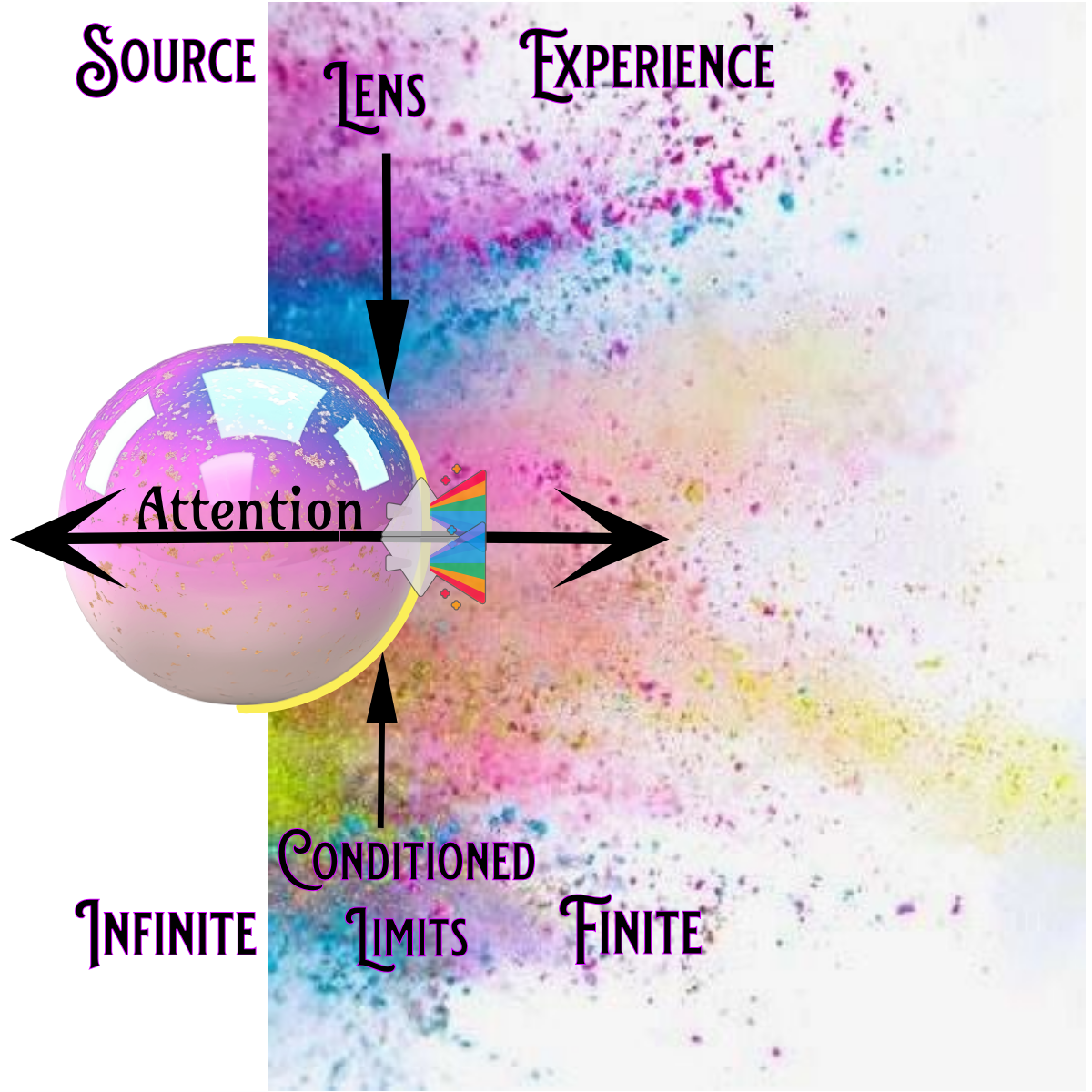
Where does your attention go? Outthere to see the occasional happy rainbow of experience, surrounded by the possibility of grey and darkness?
Turn around and let the Source, or presence, turn the lens into a prism, coloring everything in experience. To let the light in, you have to pay attention to it. Light glows brightly when you attend to it.
A diagram is helpful, but it’s not enough. Like an inhabitant of Plato’s Cave, turn towards the light rather than reacting to shadows on the wall. Is your perception true? Is it a world imprisoned by and through a glass darkly; a world of shadows? Or is it shot through a prism, a colorful refraction of the light within; darkness dispelled? You cannot serve two masters. Pay attention to the light, the Source of illumination. Check it out, over and over, like a lover.
After some time away, it seems auspicious to return again to participate in the universal dialogue upon which the title of this blog is based. One thing I know for sure after all these years is that this peace we’re talking about has nothing to do with any conceptual framework, spiritual or otherwise. In fact, the frame is most often a serious distraction from what it is meant to display.
In my experience, the teachings in many ways are the obscuration of what we are seeking, a cul-de-sac of sorts. Conversely, the errors in the teaching–as in what is seen when Toto pulls the curtain aside to reveal the smoke and mirrors of the powerful illusion–become the pointer to what is true.
In a kind of coincidence that in many ways defines what I’m talking about and what is always available, I was driving around thinking about what I was writing here, and a song came on, “Old Shoes” by Sean Rowe. I had not turned the music on, or iTunes, nor had I connected it to my car for some time, the song just started up about 5 minutes into the drive, seemingly out of nowhere. The line “I intend to find you on my own,” is key to where I’ve been, and to understanding the last 3 lines:
In this moment we’re alive In this moment we can die free How can I make you, make you understand?
by Sean Rowe, sung by Sean Rowe and Markéta Irglová
Please visit the Sessions page if you want to continue the discussion. Thank you to all who have shown up over the years.
The ego, which is really nothing more than a pattern, a dramedy of illusions, is an error-finding mechanism. That’s it. That’s the whole ballgame. Seeing right isn’t given to the dummy, so seeing wrong, or not at all, is all that’s available.
Seeing error everywhere is the survival strategy, the one-direction, of the oblivious false self. The sound of silence cannot be heard in a head full of complaint.
This seemingly entrenched tendency could be utilized in the way of lucid dreaming. A recommended trick to become lucid in a dream is notice the errors. A light switch doesn’t work, a hallway that leads to nowhere—something isn’t quite right. What doesn’t look right is the prompt to wake up, and become lucid.
I had a dream the other night that students were dressed in rabbit suits and lobbing snowballs at each other across a walkway on campus. I knew something was funny, and creepy, about the situation, but sadly, did not wake up. I did think, “…this looks like a trap,” and wisely took another route, and so escaped without harm.
So yes, there is something wrong. It’s only natural a contrived character would suspect as much. But it isn’t the rabbit-suited students, or the snowballs in July. It isn’t “others” or the scary circumstances. I wasn’t on any campus.
Since asking for a little help, it seems only appropriate to write about the concept of scarcity, the imagined abode of the imagined self, in an imagined world of things and others.
First, thank you to those who chipped in. One cannot donate from a sense of scarcity, but from the wisdom that is abundance, from that open place of giving.
From a sense of nothing here, something was given and received here. Gratis, as it were, leading to and arising with gratitude. Which is to give thanks. According to the online etymology dictionary, thank “is related phonetically to think as song is to sing.”
So it is like the street musician who sings and plays his guitar, with his hat out, or guitar case open. Does he/she sing from a place of scarcity? Or does the voice, the music, come from the same source, the communion, from which the coin or bill is dropped into the hat?
What is being expressed but gratitude all around?
And so I sing for my supper. As my grandfather used to conclude grace before the meal, “…and give us grateful hearts. Amen.”
Scarcity? I think not. But I thank, too, the friend who gave me two bananas and 3 lemons. From that sweetness, I will make lemonade.
By Priscilla Jane Thompson, from Gleanings of Quiet Hours, self published in 1907.
‘Tis a time for much rejoicing; Let each heart be lured away; Let each tongue, its thanks be voicing For Emancipation Day. Day of victory, day of glory, For thee, many a field was gory!
Many a time in days now ended, Hath our fathers’ courage failed, Patiently their tears they blended; Ne’er they to their, Maker, railed, Well we know their groans, He numbered, When dominions fell, asundered.
As of old the Red Sea parted, And oppressed passed safely through, Back from the North, the bold South, started, And a fissure wide she drew; Drew a cleft of Liberty, Through it, marched our people free.
And, in memory, ever grateful, Of the day they reached the shore, Meet we now, with hearts e’er faithful, Joyous that the storm is o’er. Storm of Torture! May grim Past, Hurl thee down his torrents fast.
Bring your harpers, bring your sages, Bid each one the story tell; Waft it on to future ages, Bid descendants learn it well. Kept it bright in minds now tender, Teach the young their thanks to render.
Come with hearts all firm united, In the union of a race; With your loyalty well plighted, Look your brother in the face, Stand by him, forsake him never, God is with us now, forever.
What is outside cannot be known, only projected and interpreted. “Be still and know that I am,” is a pointer to what is behind consciousness, the experiencing capacity. Experience is the dream; the dream is experiencing. Identity erroneously comes from experiencing perceptually from the POV of a seer, experiencer. Behind experience is the true identity.
There is an underestimated reason why meditation is helpful. It is a break from perception, from engagement with the world as subject/object. Perception, as it stands, cannot be anything but a separative perspective. In one sense, it is the basis of experience. Which is I guess, why we’re here, why we’re dreaming. On the other hand, it divides what is seen from the seer, necessarily. And therein lies the “problem.”
This is all rather dry and in some ways, the scientific rendition in that it is an attempt to explain, which is useless if not lived. You learn about gravity by learning to walk, not be having it explained or understanding the concept.
What is lived, emerges in childhood, is a sense of guilt, a loss of innocence. Because we are pretending to have separated from our source, and somehow become split off, individuated, and autonomous, like Pinocchio going off on his adventures. But there is a conviction, a knowing deep down, that we have fallen from grace. Yet it’s impossible.
Coming out of innocence, as a child begins the conditioning of separation, we start to think we are inherently bad. I am a bad girl, or a bad boy, is what is internalized. Not intentionally or maliciously, but in the inevitable sense of pretending to be something we are not. We didn’t really pull this separation thing off; we are only pretending. But the pretense has become so real that we are frightened, and feel guilty.
This is not what a child does, it is what Mind does. It goes out to explore and become and experience. That’s all there is. All mind; only mind. Yet somehow it gets lost in this adventure and believes it is truly here as this character, surrounded by other nefarious characters.
“There is something wrong; I need to do something,” is the alert that drives everything we do, in the dream. And it is true in that there definitely is something wrong. I am not this, and not here. I’m only sleeping. The only thing that needs to be done is to see this, and stop pretending, become unmesmerized by the dream. So this feeling of wrongness, of sin, and the hope for redemption looks like crazy cartoon characters, continuously and repetitively, trying to get something, to achieve something, to prove something, in the dream. But like Wile E. Coyote and Road Runner, it is all in vain. And no one ever really gets hurt, or dies.
If you’d quit trying to fix yourself for one minute, you’d see this as false programming for a false sense of identity. The wrongness is not in you. It is in the game of pretending to be something you are not. Pinnochio is not a real boy, independent of his father’s carving a puppet from a lump of pine. The Coyote does not really want or need, or ever capture, the illusive Road Runner. It is all a fiction that can look pretty crazy and make you laugh when truly seen.
You are neither the Boss of Everything, or the Hapless victim. The world is not as it appears. Nor are you. Wake up!
When I wake up early in the morning Lift my head, I’m still yawning When I’m in the middle of a dream Stay in bed, float up stream (float up stream)
Please, don’t wake me, no, don’t shake me Leave me where I am, I’m only sleeping
Everybody seems to think I’m lazy I don’t mind, I think they’re crazy Running everywhere at such a speed ‘Til they find there’s no need (there’s no need)
Please, don’t spoil my day, I’m miles away And after all I’m only sleeping
Keeping an eye on the world going by my window Taking my time
Lying there and staring at the ceiling Waiting for a sleepy feeling
Please, don’t spoil my day, I’m miles away And after all I’m only sleeping
Writing about the illusory nature of problems can look like a denial, or outright ignorance, of what today appears to be a highly problematic state of the world. There is a battle going on, right? Many social media posts speak of love and mindfulness and peace. All well and good, but do they meet the demands of the visible unrest?
Do these mindfulness reminders create a restful moment of pause, or do they engender more anger as a striking lack of awareness? Seemingly irrelevant tropes in the face of powerful upheaval–akin to bringing a rubber knife to a gunfight?
Concepts of love, mindfulness, and peace are empty, and thus not a source of solace. We cannot talk or write or read about these ideas unless they are transformed and lived. Love is not the selective feeling of affection and connection to a delineated few. Mindfulness is not a scheduled respite, a moment or two taken out of time in the midst of conflict. Peace is not an impossible goal to be hoped for sometime in the future, and not really an agreement between two or more parties.
Peace is an allegiance to the calm that always can be found under or behind the storm. Not a break from it, but a dwelling as and in that calm. Mindfulness as a way of being. Ultimately, it becomes the realization of no-differences when the two or more are the illusion, the false segregation created by the split mind. The experiential realization of inseparability is love.
The hardest thing to accept right now is that the division is within, is projection. Anger and fear are the unavoidable manifestation of this inner conflict projected out there. Even if you don’t or can’t believe this premise, there is a close-enough proximation of being the equanimity in the midst of outbursts all around. See the power and the solace in the refusal to give in to the temptation of helpless fear or an over-wielding anger.
The need to be right is a powerful force. It is, however, a weak defense in this shadowy world of not really knowing, of honest uncertainty.
In those most disorienting moments of there-is-something-wrong-I-need-to-do-something distress, some response will and always does emerge in the space that is beyond fear and anger. It helps to realize we are not in charge, but simply vehicles of this greater intelligence. Simply allow the response, the doing/done, to emerge.
Let it come from the equanimity that comes from trust in this larger/largest Source. And it will be reflected, this trust, this returning, out there. You will then more often notice images like that of the young white girl jumping in front of the young black male as the police move towards him, or the National Guardsman who takes a knee in solidarity with the protestors. That is the unitive perception, instead of the fearful division.
That is why you are here. You are/I am the unbiased witness, like the sun, that does not discriminate where it alights. And fear and anger will dissipate, if only for a moment. And that is the moment that matters, that fearless space of clarity and inseparability.
And in the silence, the vastness, of the indiscriminating light, the response comes through you, not from you.
You don’t need to do anything in particular. Forget the particular, the perception of parts, of right and wrong. There are no parts in this Whole.
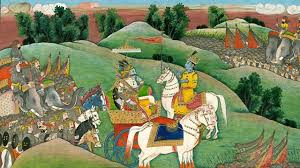
Why did Krishna tell Arjuna that he must fight, as he stood in the midst of the battlefield,? Is he not fighting the doubt he feels in seeing this world split in two? Where is the battlefield? The great divide, thus the great anguish?
“It was Vyasa’s (the author’s) genius to take the whole great Mahabharata epic and see it as metaphor for the perennial war between the forces of light and the forces of darkness in every human heart.” ~
If you let go of that question, that complaint, that frustration, that need, that anger, that belief/assumption—-its all mental, right? Let it all go by. And make no demands upon the bodily reactions to those mental instigations, just acknowledge how the body is playing its part in the scene building. If there is this pause, this intervention, two things can/will happen. Continue reading →
















 The Deepest Peace