There Is Nothing BUT Artificial Intelligence

There Is Nothing But Artificial Intelligence

We say “artificial intelligence” as though there were another kind. As if the mind that created it doesn’t make mistakes and hallucinate. What is the human mind if not a thought-generating machine trained on past data? A Course in Miracles says, “My mind is preoccupied with past thoughts.”  Brings to mind an airplane restroom with the “Occupied” light on: already full, no entry.

Every thought we’ve ever had is a rerun, grounded in a belief-biased, interpretive database. We are language models of our own conditioning. Maybe the fear of artificial intelligence is not that it will outthink us, but that it mirrors how we already think — automatically, habitually, from the archive of what was.

It’s the past predicting, reliving and emulating the present, algorithms built on memory, feeding you what you already know. One biological, one digital. Both simulate wisdom from stored impressions. This is the secret the machines inadvertently reveal. They make our imitation obvious. They show us the puppet strings of language, the algorithm of identity.

The danger isn’t that AI will replace us. The recognition is that it already has — because “us” was only ever an idea trained on data. The human mind is not wiser than AI — only an older dog with no new tricks. Both simulate meaning from stored impressions. Both build worlds out of fragments.

Why are we afraid of what already exists? What is being revealed isn’t the birth of something new and dangerous. It’s the exposure of the mechanism of thought itself.

“Man is a machine, but a very peculiar machine, for he is able to be aware that he is a machine.” ~ G. I. Gurdjieff

Please leave a comment, subscribe, and consider hitting the “Donate” button if you’d care to offer your support. Thank you.

Inner Buffoonery: Send In the Clowns

Listening to a conversation about American politics—ironically, in a nondual discussion group—suddenly it seemed so clear: the cartoon version of the American president was/is the same buffoon running the show in our own minds. The David Bohm rendition of “…’my’ thought is part of the system. It has the same fault as the fault I’m trying to look at.” The figure out there, idolized or despised, is nothing more than the inner buffoon—the one who insists it’s right, who pretends to rule, who I mistake myself for–the fake-tan, blustering caricature within.

This is always the case. Projection, as a shield against the truth of our own inauthenticity.

“Send in the clowns” is a theatric term, used when the play has collapsed: distract the crowd, cover the disaster with laughter. The clowns arrive because the show is already broken.

So—who’s your daddy?

“Thought creates the world and then says, ‘I didn’t do it.’” ~ David Bohm

“You’re on earth. There’s no cure for that.” ~ Samuel Beckett

Please leave a comment, subscribe, and hit the “Donate” button if you’d care to offer your support. Thank you.

March Thinking Dialogues ~ Dates/Times

Flower Petal and the Puppy

Flower Petal and the Puppy

Please let me know if you wish to continue participating in these group calls. If there is sufficient interest, we will resume the second week in March. There will be no calls the first week of March. And there will no longer be dialogues on Saturdays, after February 28th. I am looking into a possible 3rd date and time during the week, which will depend upon interest and availability of those who are interested in participating. So let me know if and when. Due to various differences in time changes, March calls will take place on Tuesdays at 9:30 am and Thursdays at 1 pm, all MDT, Denver Time. This might change in April, after all the clocks have been set forward or backward.

If you’re interested in observing the body/mind and its reflexes, but you cannot make the calls, there will be the option of subscribing to the recordings of the calls, for the same price–$40 for 4 1 1/2 hr recordings. I’ll send the link for the “best of” once a week.

It’s hard to express the gratitude and awe that has been experienced in hearing all these voices, as One Mind, over the last couple of months. Mind is not, it seems, a big hairy entanglement, but more like a rascally puppy that doesn’t know what it is doing, but can be pointed in the right direction. Chewing up your shoes, and pooping on the floor is not an expression of aggression. It is not the absence of love, but an exuberant confusion of boundaries. It doesn’t know what it is doing, this playful pup, and is unfamiliar with right and wrong, and boundaries. And it knows not what the body does, or the inside from the outside. It can be loved “into alignment,” and never lose that wild exuberance, that playfulness.

Clearly, words and metaphors are limited. Pandering to puppy love is an apparent result of the limits of language. Please let me know if you’re interested in continuing to look into thought and its unpredictable yet entirely predictable antics. You can contact me at colette.kelso@gmail.com.

Thank you all for the wild ride.puppy6

Reuniting the Apparent Mind/Body Split

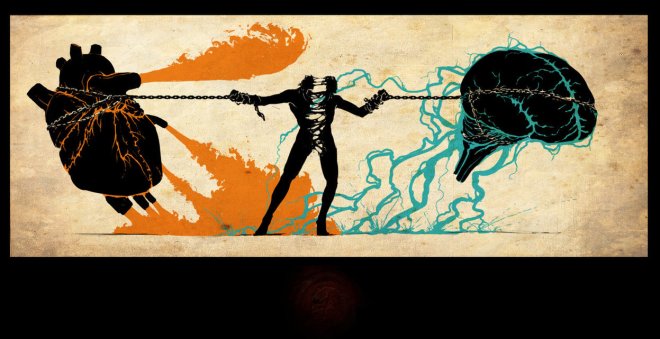
Split, by Rodrigo-Vega

There is much talk of the importance of the body and it’s contractions, feelings, in this spiritual marketplace. Though the dialogues we are engaged in are called “Thinking Dialogues,” they in no way exclude the body. The title of the book that is, in part, the inspiration for these dialogues, is Thought As A System, by David Bohm. And upon investigation, whether we are looking into thoughts, sensations, images, or sense perceptions, it is just that—a system, not of divided parts, but the undivided experience prior to the idea of parts. Continue reading

Thought is Like Quicksand

Cartoon duck

“What’s the big idea?” ~ Donald Duck

Thought is like quicksand–one step, and “you” are in it up to your neck.

But we can learn all about quicksand, mostly how to recognize it, so you don’t get stuck in the mire.

Then you can step around it, like a seasoned eco-traveller.

Or go ahead and sink, losing all–or nothing.

Whaddya know?

Want to join the Thinking Dialogues? Click on the hat!

quicksand


Going to the Land Beyond Belief~Confabulating Oz

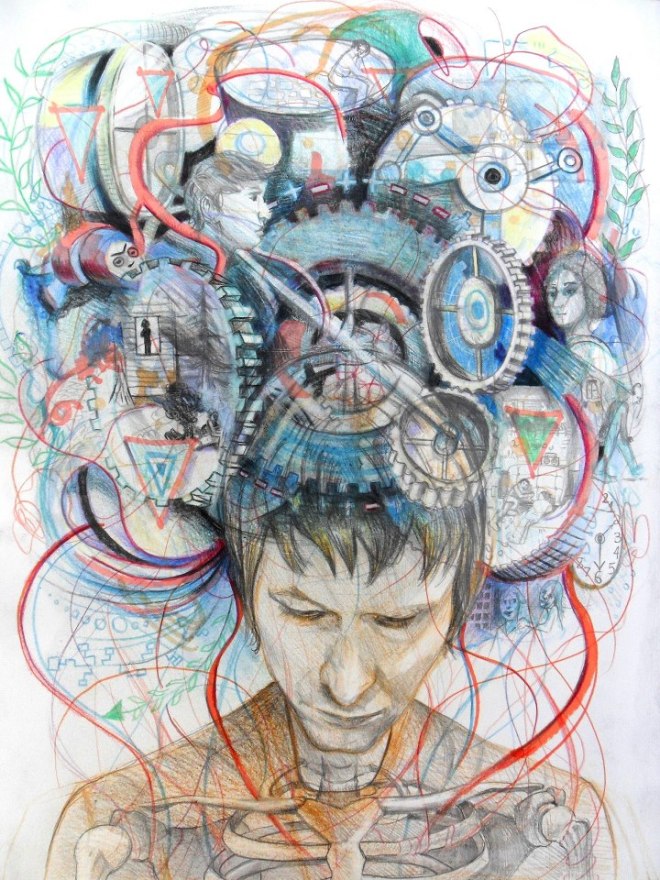
Becoming Aware of the Mind, by Andrew Gable

Becoming Aware of the Mind, by Andrew Gable

Thought persists, but does our belief in it, and identification with it, have to continue as a persistent way of living, albeit incoherently? Is there a gap in which to look and see–does thought really tells us the way life is and who we are? Or is it the very thing that creates what life appears to be, and all the changing ideas we have of ourselves?

Inspired by the book, Thought as a System, by David Bohm, I’m proposing opportunities to look as a group at the mechanics of thought, how it both plays tricks and doles out treats—moment by moment.

Thought/mind is a system. It has its fixations, reflexes, coherence and incoherence. It is in cahoots with the body, also part of the reflexive system, that appears to make thoughts evidence of truth, of identity–this opinion is true; it is mine; it is who I am. I know because I feel it.

Thinking in and of itself is not the problem. It’s useful, necessary, and highly creative. But incoherent thinking can be observed, and perhaps in that seeing, become coherent, servant rather than master.

I’m starting a series of group dialogues on the incoherent tendencies of thought and how that incoherence manifests as feeling as if what thought says were true, and seemingly coherent. It can mean the difference between being at war or in peace with ourselves and the world, which are one and the same–in thought.

Attention to thought is not exclusive to nonduality. Where is Buddhism, Christianity, Advaita, Zen, but in the objectifying, the structural nature of thought? Incoherent thinking impacts everything from politics, the environment, world hunger, family, relationship, and my/your life as it is lived day to day.

Perhaps we won’t have so many “problems” to solve, if we are able to watch how the problem is created. This ongoing dialogue could be thought of as a kind of “thinking school,” where the separative, divisive, personalized tendency of thought is seen for what it is, in the crucible of the group, from the premise of inseparability. One mind, not my mind and his/her mind.

There will be three 1 1/2 hr dialogues per week, to accommodate time differences. They will be held on Tuesdays at 9:30 am, and Thursdays at 1:00 pm, and Saturdays at 9:30—all MDT, beginning January 6th, 2015.  The idea is to look at this on a weekly basis until Toto pulls the curtain aside and there is less smoke and mirrors and more-kindly-old-man-from-Kansas running the show. The kingdom of Oz is not———what we think it is.

Having decided that looking at incoherent thought is absolutely separate from and more important than the money charged or the money to be made, I am changing the price structure, literally reducing the cost by over 50%. Because I do have to show up, keep track of who is coming,  send out invites, answer questions, update the website with developments, and other administrative costs, the price has been reduced to $40 per month, for 1 call a week, which will add up to 4 calls per month, 6 hours of dialogue time. depending upon the month. These dialogues will be ongoing, for as long as interest (and/or the tendency towards incoherent thinking) continues.

If interested in exploring and exposing the mechanics of mind through group dialogue, please contact me at Colette.kelso@gmail.com The book, Thought As A System, by David Bohm, is available as a downloadable pdf here–in addition to the link above. More details can be found on the Thinking Dialogues page.

Beyond the Yellow Brick Road ~ eone Film

Beyond the Yellow Brick Road ~ eone Film